 Last Friday evening, after I lit the Sabbath candles, we heard a sudden deafening noise from the kitchen. I headed over to investigate despite my husband warning me away. He was sure the kitchen was about to explode.
It turned out that the pressure cooker was leaking tomato sauce all over the hotplate, where I had placed the pot to keep warm until dinner. Large amounts of sauce spread from the hotplate to the counter, the dishwasher underneath, and the floor. I adjusted the cooker to let out the steam and wiped up the mess as best I could.
Like most kitchen accidents, this one could have been prevented. I had filled the cooker too full of Chicken with Tomatoes and Black Olives. Admittedly I knew it was risky, although why it waited until that moment to overflow I’ll never understand.
It was a big mess, but it could have been worse.
Even when no one gets hurt, kitchen accidents waste both food and time. Accidents are most likely to happen when you are rushed, distracted, or under pressure. Here are some tips to prevent both minor and major kitchen accidents.
- Choose the right-sized pot for the job. Many pots, food processors and electric kettles have a line on the side marking the maximum capacity. They tend to be conservative. Keep in mind that grains and beans make more foam than other foods. Also choose a large container when transferring liquids, and move the bowl next to the sink when adding water from the tap. (Never add water to a bowl of food straight from the tap, in case you add too much).
- Keep heavier equipment and glassware on lower shelves, or on the counter if you use them frequently. If you have small children, keep cabinets locked.
- Keep your floor and working space clear. Take the extra effort to remove clutter before starting to cook, or things can fall off the counter or table. Move non-cooking items out of the kitchen, and vice-versa.
- Cook when you have a minimum of distractions, especially when you are trying something new or complex. Stick to simple recipes when cooking with small children around. Use a timer to remind you to check food, and when it’s to go on to the next step. If you have to leave the kitchen to answer the phone or door, set the timer or turn off the stove completely.
- Tie up long electric cords with a rubber band to keep them out of the way. Turn pots so that the handles are on the side and not sticking out in the front, where someone could walk into it or a child could grab it.
- Close packages and containers immediately and securely. You don’t want water to drip into your flour tin. Use a clothespin or breadtie for bags. Things with a tendency to leak can go in a plastic bag.
- Don’t crowd things. If you push things into the refrigerator, you may knock over things in back or keep the refrigerator from closing properly. Utensils stacked carelessly can topple.
- Protect yourself with proper clothes, clothes, shoes, gloves, or oven mitts, especially when working with boiling water or hot oil.
- Keep knives sharp. You’ll need less pressure to slice the items, and if you do cut yourself the wound will heal faster.
- Keep items in their designated place. Your pancakes will burn while you’re searching for the spatula, and you don’t want to accidentally find a knife blade instead. Don’t soak items with sharp blades in soapy water.
Have you had any kitchen accidents recently? Share in the comments!
Photo credit: Chris Denbow
11 Tips for Easy Kitchen Cleanup


I like your suggestions. I would add, regarding small children and cabinets – perhaps you can keep one or two cabinets holding unbreakable, non-toxic items open for small children to play in. From the time my daughter was 10 months old or so, she loved to go through cabinets and empty them out (thanks to diligent training by my husband, she now loves to reassemble them, too. What a wonder!) It was a great distraction for her while I was cooking and limited the amount of time spent pulling at my leg crying “mama” (which, in my experience, is also a big cause of kitchen accidents.)
Ms. Krieger: I used to have a drawer like that too. Great training by your husband. And true about the leg-pulling. I’ve written more about children elsewhere, but once you get to the leg-pulling point it is usually too late to do any serious cooking.
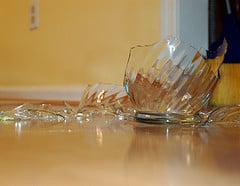
In the house we are in now we have to be very careful about what is kept where as far as breakables are concerned. Our kitchen floor is so hard that nothing survives being dropped onto it. Makes it easy to clean but a nightmare if you drop anything.
Cake Lady, I have the same problem with my floors. Sorry I missed responding to your comment earlier.
Wear gloves when handling hot peppers. I once chopped a few hot peppers by hand and my palms felt like they were on fire-nothing helped and even after repeated hand washings, soaking in various solutions and applying different ointments and concoctions and more hand washing, at the end of the day when I took out my contact lenses there was still enough residue from the peppers to make the contacts unwearable.
Channa, sorry about the contacts! I’ve only used hot peppers a few times.